Fishing Reel Size Chart: Spinning Reel Sizes by Brand
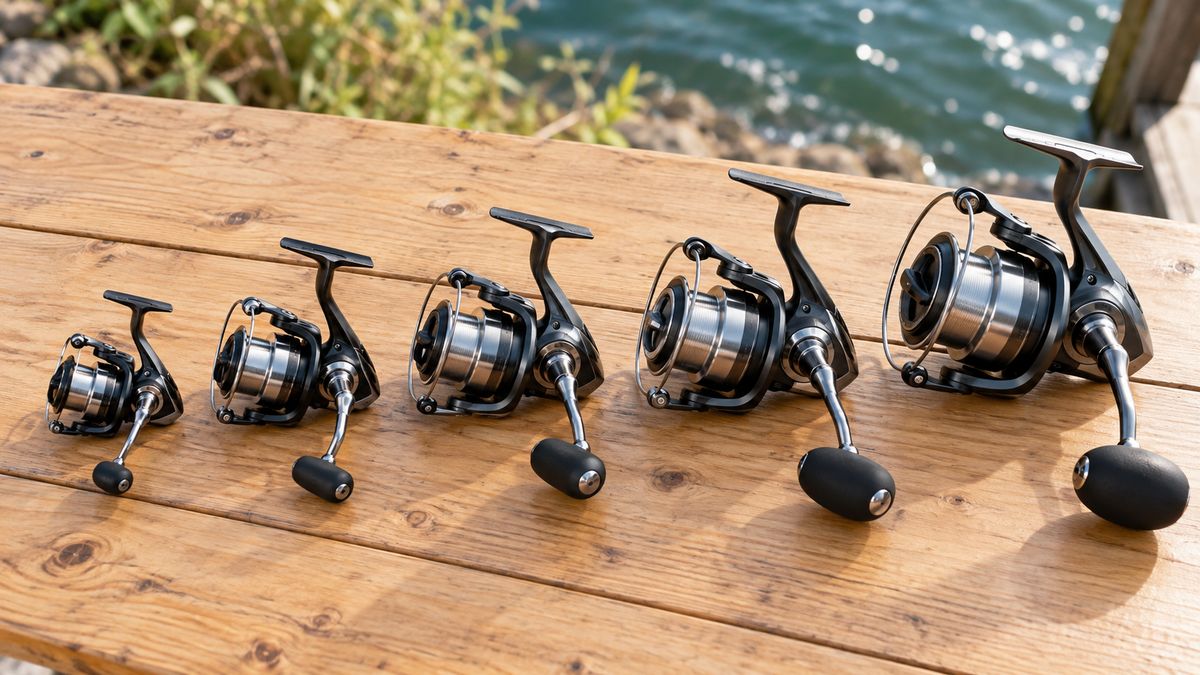
Illustrative image, not the exact model.
A spinning reel's size number is a class label, not a measurement. Shimano, Daiwa and PENN each run their own scale, so two reels marked 3000 can carry different line ratings and weigh noticeably different amounts.
The chart and tables below come from manufacturer spec sheets for ten current US series, plus the Shimano Japan and Daiwa Japan sizing charts that define what the numbers stand for. Compare sizes across brands first, then narrow the choice by line and species.
Spinning reel sizes across brands
What each size class is for
| Size class | Typical use | Line |
|---|---|---|
| 500 | Stream trout on ultralight gear with 4 lb mono (Bass Pro 1Source names a Shimano Sedona 500); Panfish such as bluegill, crappie and perch, including through the ice (Shimano North America names the Nasci FD 500 or 1000) | Bass Pro 1Source pairs a 500-size reel with 4 lb nylon monofilament for ultralight trout. |
| 1000-1500 | Light freshwater: trout, grayling, perch, put-and-take (Daiwa, 1000-2500); Panfish (bluegill, crappie, perch) and fish under about 3 lb (Shimano North America: Nasci FD 1000 or 500); Light inshore saltwater, small fish such as pinfish, trout, flounder, snapper (PENN, 1000 and 1500); Japanese light saltwater (aji, mebaru) and trout (Daiwa Japan, SF/LT1000) | PENN Battle IV 1000 is rated for mono 140 yd/4 lb, 110/6, 95/8 and braid 125 yd/8 lb, 110/10, 100/15. Shimano Stradic FM ST1000HGFM is rated for mono 2-270, 4-160, 6-110 (lb-yd) and PowerPro 10-95, 15-75, 20-65. |
| 2000-2500 | Finesse bass fishing (Shimano North America calls the Exsence 2500XGB 'the perfect spinning reel for targeting bass with finesse tactics'); Bass: Shimano Japan calls the 23 Stradic 2500S its standard bass model; Daiwa Japan lists LT2500 for bass, eging and trout, and SF2500 for bass on light line up to about 4 lb; Walleye, pike and trout through the ice and in open water (Shimano North America: Vanford A 2500 or 3000); Light inshore: trout, flounder, redfish, jack, snook (PENN, 2500); pinfish, trout, flounder, sheepshead (PENN, 2000); Light freshwater: trout, grayling, perch (Daiwa, 1000-2500); coastal sea trout and sea bass in Europe (Daiwa, 2500-3000) | PENN Battle IV 2500 is rated for mono 255 yd/6 lb, 175/8, 140/10 and braid 240 yd/10 lb, 220/15, 160/20. Shimano Stradic FM ST2500HGFM is rated for mono 8-140, 10-120 and PowerPro 10-150, 15-145, 30-100 (lb-yd). Daiwa Japan rates the SF2500 for bass on line up to about 4 lb. |
| 3000 (C3000) | Inshore, medium fish: trout, flounder, redfish, jack, snook (PENN, 3000); flounder, redfish, jack, snook, cobia (PENN, 3500); All-round freshwater-to-saltwater: Shimano Japan calls the 23 Stradic C3000 a 'versatile model you can use for anything from freshwater to saltwater'; Pike (Daiwa, 3000-4000); walleye, pike and trout (Shimano North America: Vanford A 3000); Japanese seabass, black seabream, deep-water eging, bass, trout (Daiwa Japan, LT3000) | PENN Battle IV 3000 is rated for mono 200 yd/8 lb, 165/10, 120/12 and braid 250 yd/15 lb, 180/20, 130/30. Shimano Stradic FM STC3000XGFM is rated for mono 6-230, 8-170, 10-140 and PowerPro 10-200, 20-140, 40-105 (lb-yd). |
| 4000 | Inshore, pier and nearshore, medium fish: redfish, jack, snook, cobia, tarpon (PENN, 4000); redfish, jack, snook, tarpon, barracuda (PENN, 4500); Pike (Daiwa, 3000-4000); Surf: Shimano Japan calls the 23 Stradic 4000XG its standard surf model; Japanese seabass, flatfish, large trout, salmon, light jigging and light shore jigging (Daiwa Japan, LT4000) | PENN Battle IV 4000 is rated for mono 270 yd/8 lb, 220/10, 165/12 and braid 360 yd/15 lb, 260/20, 185/30. Shimano Stradic FM ST4000XGFM is rated for mono 10-200, 12-160 and PowerPro 15-230, 30-180, 50-120 (lb-yd). |
| 5000-6000 | Inshore/nearshore, large fish: king mackerel, snook, tarpon, barracuda, grouper (PENN, 5000); nearshore/offshore (PENN, 5500); Nearshore, surf and offshore, large fish: tarpon, barracuda, shark, mahi, tuna (PENN, 6000); Light shore jigging and light shore casting for Japanese yellowtail-type species (Shimano Japan, 23 Stradic C5000XG); Light shore jigging, light jigging, seabass, flatfish, large trout (Daiwa Japan, LT5000-C); jigging and shore jigging (Daiwa Japan, LT6000); Serious saltwater fishing such as cod, pollock and halibut in Norway (Daiwa, 4000-8000) | PENN Battle IV 5000 is rated for mono 225 yd/12 lb, 200/15, 135/20 and braid 420 yd/20 lb, 300/30, 240/40; Battle IV 6000 is rated for mono 335/15, 230/20, 210/25 and braid 490/30, 390/40, 335/50. Shimano Stradic FM STC5000XGFM is rated for mono 12-195, 14-165 and PowerPro 20-260, 30-235, 40-185 (lb-yd). |
| 8000+ | Nearshore, surf and offshore, very large fish: tarpon, shark, mahi, tuna, wahoo (PENN, 8000); plus sailfish (PENN, 8500-9000); Heavy surf (PENN, 9000-9500) and extreme surf (PENN, 10000-10500); trophy fish such as large shark, tuna, wahoo, sailfish (PENN, 9500+); Bluewater fishing for large, hard-fighting species such as giant trevally (Daiwa, 8000+) | PENN Battle IV 8000 is rated for mono 340 yd/20 lb, 310/25, 230/30 and braid 475 yd/50 lb, 390/65, 345/80; Battle IV 10000 is rated for mono 395/30, 330/40, 230/50 and braid 770/50, 710/65, 490/80. |
What size spinning reel for bass, trout, inshore and surf
How Shimano, Daiwa and PENN number their sizes
Shimano
Shimano spinning sizes are 3- to 5-digit numbers (500, 1000, 2500, 3000, 4000 ... up to 30000 on Stella SW). The number is not a spool diameter: in Shimano Japan's 23 Stradic spec chart, the 2500, C3000 and 3000MHG all use a 47 mm spool, and the 4000 and C5000XG both use a 52 mm spool. A 'C' prefix marks a compact body: Shimano Japan describes the C2000S as a 2000-size spool on a 1000-size body and rotor. Suffix letters after the size give spool type and gear ratio (S = shallow spool, M = M spool, PG = power/low gear, HG = high gear, XG = extra-high gear, DH = double handle). US model numbers add a series prefix and a generation code (e.g. STC3000XGFM = Stradic, C3000, XG, generation FM).
- Shimano Japan describes the 23 Stradic C2000S as a model that mounts a 2000-size spool on a 1000-size body and rotor (「1000番サイズのボディ&ローターに2000番サイズのスプールを装着」).
- Shimano Japan describes the 24 Twin Power C2000SHG as a high-speed model on a 1000-size body (「1000サイズのボディにハンドル一巻き81cmのハイスピードモデル」).
- The 3000MHG is the exception that goes the other way: Shimano Japan describes it as a 3000 model that puts a compact 2500-class spool and rotor on a 4000-class body, and says its spool is interchangeable with the 2500 and C3000.
- Spool diameter / stroke in the 23 Stradic (Japan) spec chart: C2000S/C2000SHG 43/13.5 mm; C2500S/C2500SXG 44/13.5 mm; 2500S/2500SHG, C3000/C3000HG/C3000XG and 3000MHG 47/17 mm; 4000/4000MHG/4000XG and C5000XG 52/19 mm.
- Because the 2500S and C3000 share the 47 mm spool, the difference between them in the 23 Stradic is spool depth: the 2500S is rated PE 0.6-200 m / 1-120 m, while the C3000 is rated PE 1-400 m / 2-200 m (Japanese PE numbers).
- Weights in the same chart: 2500S 220 g, C3000 225 g, 3000MHG 245 g, 4000 275 g, C5000XG 290 g.
- US model numbers carry a series prefix and generation code: the US Stradic FM lineup is ST1000HGFM, ST2500HGFM, STC3000XGFM, ST4000XGFM and STC5000XGFM.
- A shallow-spool 'S' model in the US: Shimano North America says the new Vanquish 2500S 'features a shallow spool arbor engineered specifically for ultra-thin braid'.
Daiwa
Most current Daiwa spinning reels use LT sizing. Daiwa US defines LT as 'Light and Tough' (a smaller body with a larger DigiGear). In LT sizing the number maps to a fixed spool diameter: SF/LT1000 = 40 mm, SF/LT2000 = 42 mm, SF/LT2500 = 45 mm, LT3000 = 48 mm, LT4000 = 51 mm, LT5000 = 54 mm, LT6000 = 57 mm. After the size come spool depth (D deep, none standard, S shallow, SS extra shallow, SSS ultra shallow), an optional -C for a body one size smaller, the gear ratio (P, none, H, XH) and handle options (DH double handle, QD quick drag). Daiwa Australia's sizing table shows that LT numbers are not the same as Daiwa's older (pre-LT) numbers.
- Daiwa US glossary: 'LT — Light and Tough. Smaller body design yet with larger DigiGear drive for the perfect combination of lightness and toughness.'
- Daiwa Japan's LT/SF model-number chart gives spool diameters: SF/LT1000 φ40 mm, SF/LT2000 φ42 mm, SF/LT2500 φ45 mm, LT3000 φ48 mm, LT4000 φ51 mm, LT5000 φ54 mm, LT6000 φ57 mm.
- Daiwa Japan's chart reads a model number such as EXIST FC LT2500S-CXH-DH as: series / special code (FC = Finesse Custom, PC = Power Custom, ST = Sensitive Tune) / size (spool diameter) / spool depth (D = deep, none = standard, S = shallow, SS = extra shallow, SSS = ultra shallow) / -C (compact: a body one size smaller) / gear ratio / handle code (DH = double handle, QD = quick drag).
- Daiwa Japan's gear-ratio bands: P = 4.9 or lower; no letter = 5.0-5.4; H = 5.5-5.9; XH = 6.0 or higher.
- Daiwa Australia's LT sizing table puts old and new sizes on the same spool-diameter scale: old 1000 = 40 mm, old 2000 = 43 mm, old 2500 = 48 mm, old 3000 = 54 mm, old 3500 = 55 mm, old 4000 = 57 mm; LT1000 = 40 mm, LT2000 = 42 mm, LT2500 = 45 mm, LT3000 = 48 mm, LT4000 = 51 mm, LT5000 = 54 mm, LT6000 = 57 mm. So an old Daiwa 2500 matches an LT3000 in spool diameter, an old 3000 matches an LT5000, and an old 4000 matches an LT6000.
- Daiwa Australia says the varied gaps between old sizes worked when monofilament was standard, but braid lets anglers use smaller reels effectively, so LT standardises spool diameters and 'expands 4000 to 6000'.
- Daiwa also re-sized heavy saltwater reels starting with the 20 Saltiga, so that two reels with the same number no longer have very different capacities (Daiwa's example: Certate LT 5000 at PE 2/300 m vs 15 Saltiga 5000 at PE 5/300 m). The 15 Saltiga 4500/5000/5500/6500/8000 correspond to the 20 Saltiga 8000/10000/14000/18000/20000.
- Daiwa's European guide: 'The higher the number, the larger and stronger the reel, with more line capacity and drag power.' It explains the letters as no letter = standard ratio, H = High speed, XH = Extra High speed, P = Power (a slower ratio with more torque).
PENN
PENN's online Reel Size Guide lists spinning sizes from 1000 to 10500 in steps of 500, each matched to a fishing type and species size. On current models such as the Battle IV, the 'HS' suffix marks a High Speed version of a size (BTLIV4000HS at 7.0:1 vs BTLIV4000 at 6.2:1). PENN does not say whether its numbers line up with Shimano or Daiwa sizes.
- PENN's Reel Size Guide (shown on its spinning-reel product pages) covers sizes 1000, 1500, 2000 ... 10000, 10500, and lists a fishing type and example species for each.
- Battle IV is offered in sizes 1000, 2000, 2500, 3000, 4000, 5000, 6000, 8000 and 10000, in Standard Speed and High Speed versions (e.g. BTLIV4000 6.2:1, BTLIV4000HS 7.0:1; BTLIV6000 5.6:1, BTLIV6000HS 6.2:1; BTLIV8000 4.7:1, BTLIV8000HS 5.3:1).
- No PENN page we found states an equivalence between PENN sizes and Shimano or Daiwa sizes.
Model-name suffixes (HG, XG, PG and more)
- C (Shimano, prefix): Compact body: the spool size in the number on a body one size smaller (e.g. C2000S = 2000 spool on a 1000 body).
- -C (Daiwa): Compact: used when the reel has a body one size smaller (Daiwa Japan: 「ワンサイズ小さいボディを採用する場合」).
- HG (Shimano): High gear. Shimano Japan calls the C2000SHG 'the high-gear model of the C2000 series'.
- XG (Shimano): Extra high gear. Shimano Japan calls the C2500SXG 'the extra-high-gear model of the C2500S' and the C3000XG 'the fastest-retrieve model of the C3000 series'.
- PG (Shimano): Power gear: Shimano Japan describes the 24 Twin Power 4000PG as the power model with low gearing, a long handle and a round knob, giving the most cranking power.
- no gear letter (Shimano): Normal gear ratio. Shimano Japan describes the 23 Stradic C3000 and 2500S as normal-gear-ratio models suited to slow presentations.
- S (Shimano): Shallow spool. Shimano North America: the Vanquish 2500S 'features a shallow spool arbor engineered specifically for ultra-thin braid'. Shimano Japan calls the Sedona 2500S PE1010 a shallow-spool model.
- M (Shimano): M spool: Shimano Japan says the 4000M/4000MHG carry an M spool suited to PE line of 1 to 1.5 (Japanese PE number).
- DH (Shimano, Daiwa): Double handle. Shimano Japan calls the 24 Vanford C3000SDH a double-handle model popular for eging (squid fishing), added for more stable reeling. Daiwa Japan lists DH = double handle.
- P / (none) / H / XH (Daiwa): Daiwa gear-ratio bands: P = 4.9 or lower, no letter = 5.0-5.4, H = 5.5-5.9, XH = 6.0 or higher. Daiwa's European guide: H = High speed, XH = Extra High speed, P = Power (slower, more torque).
- D / S / SS / SSS (Daiwa): Spool depth: D = deep, no letter = standard, S = shallow, SS = extra shallow, SSS = ultra shallow.
- QD (Daiwa): Quick drag (handle-side special code in Daiwa Japan's chart).
- FC / PC / ST (Daiwa, prefix): Special codes: FC = Finesse Custom, PC = Power Custom, ST = Sensitive Tune.
- HS (PENN): High Speed version of a size, e.g. Battle IV BTLIV4000HS (7.0:1) vs BTLIV4000 (6.2:1).
How to read this reel size chart
Each dot in the chart is one current US model plotted at its nominal size against its published weight. Rows in the table group models by the number in their name, so a Shimano C3000 sits in the 3000 row and a Daiwa LT4000D-C sits in the 4000 row. Reading across a row compares brands at the same label; reading down a column shows how one series steps up.
The spread inside a single row is the first thing to notice. At 3000, the Vanford C3000XG is listed at 6.3 oz, the Sedona C3000HG at 8.6 oz and the Battle IV 3000 at 11.6 oz. The number sets the spool class; it says nothing about the build or materials of the reel around it.
The braid figure in each cell is the first rating that brand prints, and brands pick different line strengths to quote. Shimano leads its C3000 rating with 10 lb braid, PENN leads its 3000 with 15 lb. Compare capacity at a matching line strength, not first number to first number.
Why a 3000 is not the same reel across brands
Shimano's number is not a spool diameter. In the 23 Stradic chart the 2500, C3000 and 3000MHG all use a 47 mm spool, and the 4000 and C5000XG both use 52 mm. The C prefix means a compact body: the spool named in the number sits on a body one size smaller.
Daiwa's LT system does tie the number to diameter: LT2500 is 45 mm, LT3000 is 48 mm, LT4000 is 51 mm. Older Daiwa sizes ran larger, so an old Daiwa 2500 matches an LT3000 in spool diameter and an old 3000 matches an LT5000. Anyone replacing a pre-LT Daiwa like for like should expect a higher LT number.
Set side by side, the two official charts put Shimano's 2500/C3000 spool between Daiwa LT2500 and LT3000, and Shimano's 4000/C5000 spool between LT4000 and LT5000. That comparison is derived from both charts rather than stated by either maker, and diameter is only one dimension; spool depth and stroke also set capacity.
- Shimano C3000: a 3000-class spool on a smaller body, with a 47 mm spool in the 23 Stradic chart.
- Daiwa LT3000: 48 mm by definition. A -C suffix, as on the BG LT4000D-CXH, puts the named spool on a body one size down.
- PENN 3000: a step on PENN's own scale, defined by species and line ratings rather than a published spool diameter.
2500 vs 3000 spinning reel: what actually changes
On a Shimano reel the 2500 and C3000 share spool diameter and stroke, so the step is depth. At Japanese PE 1 braid, the 23 Stradic 2500S is rated for 120 m and the C3000 for 400 m, while the Japanese chart lists them at 220 g and 225 g. In the US Stradic FM, the ST2500HGFM holds 120 yd of 10 lb mono and the STC3000XGFM holds 140 yd at the same strength, for 7.8 oz versus 7.9 oz.
Daiwa and PENN make the step larger. Daiwa's LT2500 to LT3000 is a real diameter change, and the BG LT goes from 8.5 oz to 9.3 oz. The Battle IV moves from 9.7 oz and 12 lb of max drag at 2500 to 11.6 oz and 15 lb at 3000.
Manufacturer guidance splits the two by use. Shimano Japan calls the 2500S its standard bass model and the C3000 a versatile freshwater-to-saltwater model; PENN lists its 2500 for light inshore and its 3000 for medium inshore fish. Shimano North America names either size for walleye, pike and trout, which marks the overlap zone where line choice should decide.
Pick the size from your line first
Bass Pro 1Source's buying guide puts it plainly: the lighter the line, the smaller the reel, and the reel should be rated for the line you use most. Manufacturer capacity ratings make that rule concrete. The ranges below use the Stradic FM because it covers 1000 through C5000 in one series, with PENN Battle IV ratings for the heavier end.
- 2-6 lb mono: 1000 class. The ST1000HGFM is rated for 2 lb/270 yd, 4 lb/160 yd and 6 lb/110 yd.
- 6-10 lb mono or light braid: 2500 to C3000. The STC3000XGFM runs from 6 lb/230 yd to 10 lb/140 yd.
- 10-12 lb mono or 15-50 lb braid: 4000. The ST4000XGFM lists 50 lb braid at 120 yd.
- 12-14 lb mono: C5000. The STC5000XGFM is rated 12 lb/195 yd and 14 lb/165 yd.
- Heavy braid for big saltwater fish: PENN 6000 and up. Battle IV ratings reach 80 lb braid on the 8000 and 10000.
What size spinning reel for bass, surf and other fish
Bass is the most consistent answer in the source data. Shimano North America describes the Exsence 2500XGB as built for finesse bass, Shimano Japan treats the 2500S as its bass standard, and Daiwa Japan lists LT2500 and SF2500 for bass, with LT3000 also on its list. A shallow 2500S spool, such as the one on the Vanquish, is Shimano's answer for very thin braid.
Surf is where sources disagree most, because they describe different fishing. PENN lists 6000 through 8500 for nearshore and surf, 9000-9500 for heavy surf and 10000-10500 for extreme surf. A Shimano North America column on New England fall surf pairs a long-cast 5500 Ultegra XR with 30 lb PowerPro, and Shimano Japan calls the Stradic 4000XG its standard model for Japanese surf lure fishing. For bait, that same Shimano column asks for a reel holding at least a couple of hundred yards of 30-50 lb braid.
A 1000 is a light-line reel: Shimano North America suggests a Nasci 500 or 1000 for panfish, and PENN lists its 1000 for small inshore fish. A 4000 is PENN's inshore, pier and nearshore size and Daiwa's upper pike size.
Reading a PENN reel size chart
PENN's online Reel Size Guide runs from 1000 to 10500 in steps of 500 and attaches a fishing type and species examples to each step. The Battle IV uses mostly whole-thousand sizes, while the Spinfisher VII and Slammer IV use the half-steps: 3500, 4500, 5500 and so on.
PENN's spec tables show that capacity follows the size number across these three series. The Spinfisher VII and Slammer IV list identical mono and braid ratings at every size they share, and the Battle IV 2500 matches both at 2500. What separates them is sealing and drag hardware, not line capacity; the three-way comparison covers those. An HS suffix marks a faster version of the same size, such as the BTLIV4000HS at 7.0:1 against 6.2:1.
FAQ
What do fishing reel size numbers mean?
They are each brand's size classes. Higher numbers mean a larger spool, more line capacity and usually more drag, but the scales differ: Daiwa LT numbers map to fixed spool diameters, Shimano's do not, and PENN publishes species and line ratings instead. Compare line capacity at the same line strength when switching brands.
Should I get a 2500 or 3000 spinning reel?
In Shimano's lineup the 2500 and C3000 share a 47 mm spool, so the C3000 mainly adds depth for more line. Choose 2500 for finesse bass and lighter line; choose 3000 for heavier line, inshore saltwater or one reel that covers both. In Daiwa LT and PENN sizing the 3000 is a bigger step up.
What size spinning reel is best for bass?
Manufacturer guidance centers on 2500. Shimano North America markets the Exsence 2500XGB for finesse bass, Shimano Japan calls the Stradic 2500S its standard bass model, and Daiwa Japan lists LT2500 and SF2500 for bass. Daiwa also lists LT3000 for bass, which suits heavier line or bigger fish.
What is a 1000 size reel used for?
Light line and small fish. Shimano rates the Stradic ST1000HGFM for 2 lb to 6 lb mono, Shimano North America suggests a 500 or 1000 Nasci for panfish such as bluegill and crappie, Daiwa lists 1000-2500 for trout and perch, and PENN lists its 1000 for small inshore species.
What is a 4000 size spinning reel good for?
It is a mid-size saltwater and big-freshwater reel. PENN lists 4000 for inshore, pier and nearshore fish such as redfish, snook and cobia, Daiwa puts pike in its 3000-4000 range, and Shimano Japan calls the Stradic 4000XG its standard surf model. A Stradic 4000XG is rated for 10-12 lb mono and up to 50 lb braid.
What size reel do I need for surf fishing?
It depends on target and line. PENN lists 6000-8500 for surf and nearshore, 9000-9500 for heavy surf and 10000-10500 for extreme surf. Shimano Japan uses a 4000XG for lighter surf lure fishing, and a Shimano North America column pairs a long-cast 5500 with 30 lb braid for New England fall surf.
Is there a PENN reel size chart?
Yes. PENN's Reel Size Guide, shown on its spinning reel product pages, covers 1000 to 10500 in steps of 500 and gives a fishing type and example species for each size. PENN does not say how its numbers line up with Shimano or Daiwa sizes.
Sources (16)
Specs and facts on this page come from the manufacturers' published specifications and the pages below, checked on 2026-10-11. We have not hands-on tested these reels; this is a spec-based comparison.
- fish.shimano.com/ja-JP/product/reel/hanyouspinning/a075f00003slvodqas.html
- fish.shimano.com/ja-JP/product/reel/hanyouspinning/a075f00003slw5kqac.html
- fish.shimano.com/en-US/product/reels/spinning/frontdrag/a075f00003slvodqas.html
- fish.shimano.com/en-US/news/news-listing/vanquish.html
- daiwa.us/pages/glossary
- daiwa.com/jp/product/support/reel/spin_rl/LT_LightTough
- daiwafishing.com.au/light-tough/
- daiwa.com/scandinavia/fishing_tips/How_to_choose_spinning_reel
- pennfishing.com/products/battle-iv-spinning-reel
- 1source.basspro.com/news-tips/trout/6437/tips-trout-fishing-with-ultralight-spinning-gear
- fish.shimano.com/en-US/news/news-listing/Ice-Fishing-Starts-Here.html
- fish.shimano.com/en-US/news/news-listing/exsence-press.html
- daiwa.us/products/24-luvias-st
- 1source.basspro.com/index.php/component/k2/76-walleye-fishing/522-walleye-fishing-tackle-guide
- wired2fish.com/catfish/best-catfish-reels
- fish.shimano.com/ja-JP/product/reel/hanyouspinning/a075f00003slwfsqac.html